

TRENTON, N.J. (CN) - In the race for who becomes New Jersey's next governor, a crowded field shows fractured Democratic apparatus and Republican reliance on President Trump's endorsement.
"We have a free-for-all in a way we haven't had for decades in New Jersey," said Dan Cassino, professor of government and politics at Fairleigh Dickinson University. "Everybody came out of the woodwork to run for the office."
The difference during this gubernatorial race is that ballots may no longer use the so-called "county line," which was done away with last year after Senator Andy Kim successfully sued the state. Under the old system, county clerks could give visual priority on ballots to candidates backed by a county's political party.
Candidates vying to win the primary for New Jersey's governor on June 10 have gone under the national radar with no clear frontrunner yet. "This has been a sleepy race so far," said Matthew Hale, who chairs the Department of Political Science and Public Affairs at Seton Hall University.
However, the primary could have massive national implications since two of the Democratic nominees - U.S. Representatives Mikie Sherrill and Josh Gottheimer - are current members of Congress in New Jersey districts that could flip back to Republican control after the midterms.
"Those are competitive districts," said Cassino, who also is the executive director of FDU's poll. "If they give up their seat [after a primary win], you will see a concerted fight in a special election."
Polling
On the Democratic side, several marquis names lead the pack with differing appeals to the progressive and moderates in the party. The Democratic coalition has fractured a bit, Hale said, as candidates in the primary now try to stake out opposing wings of the party.
"New Jersey is not a far-left state - it will be a competitive election in the general," he said. "Democrat voters still outnumber Republicans by 1 million votes, but can you get all those votes to turn out when there is a divide among the candidates?"
The leader of the pack is Sherrill, a former fighter pilot and federal prosecutor. Sherrill seemingly has taken hold of the moderate Democratic vote in the primary, while mayors Ras Baraka and Steve Fulop have laid claim to the progressive side.
In the most recent poll, conducted last month by Emerson College, Sherrill lapped the other competitors, picking up 28% support among respondents, while the next-best showing was split among Fulop, Baraka and Gottheimer, all of whom netted 11% support. However, nearly a quarter of respondents were undecided in the poll.
Fellow New Jersey congressman Gottheimer has painted himself as a fiscal moderate. He was the only Democrat from the Garden State to vote in favor of detaining non-citizens accused of crimes, and he has focused his campaign on fiscal and affordability issues. "That's a message that is well-received in the general election but not so much in the primary," Hale said.
Steve Sweeney, who years ago was among the most recognizable names in the state while serving as New Jersey Senate president, is polling near the bottom but enjoys strong support in the southern part of the state.
However, many experts say that region is not as blue as it used to be - pointing to the 2019 defection of U.S. Representative Jeff Van Drew as an example of the sea change - and say Sweeney's gambit is about a decade too late. "He could win every county south of Trenton and still lose the primary," Hale said.
Among the Republican candidates, the polling gap is even greater, with reigning gubernatorial nominee Jack Ciattarelli earning 44% support to easily beat main challenger Bill Spadea's 18% in the latest Emerson poll. About a quarter of GOP voters remain undecided.
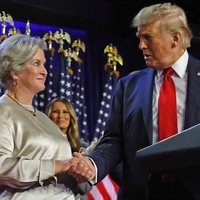
Ciattarelli, who is now on his third run for governor, has major support from southern Jersey Republicans and from Donald Trump. His polling also looks good in the rest of the state, with an internal poll reportedly showing a 31-point lead over Spadea.
That makes it a hard climb for Spadea, who was most well-known as a conservative radio host before abandoning his show to run for governor. Spadea has tried to paint Ciattarelli as disrespectful to Trump, and he has run ads giving Republican voters permission to disagree with Trump and support him despite the president's endorsement.
"This is a race around who is the Trumpiest candidate," Cassino said, noting both candidates have run advertisements accusing the other of not being sufficiently pro-Trump.
A survey of older New Jersey residents run by AARP New Jersey and Siena College found Sherrill and Ciattarelli leading their competitors by nearly the same distance, though Baraka has pulled ahead slightly of Fulop and Gottheimer in that poll.
Money
Fundraising records show a similar gap in funds among the major candidates, though the amounts raised have already broken records. According to the New Jersey Election Law Enforcement Commission, an unprecedented $59 million has been raised by the 10 major Republican and Democratic candidates, while $43 million has been spent.
Among Democrats, only Gottheimer and Sweeney come close to matching Sherrill's $4.7 million cash on hand. Gottheimer, known as a fundraising dynamo, has a bit more than $2 million cash on hand, while Sweeney has $2.2 million.
Baraka hasn't raised as much as most peers with $666,000 cash on hand as of May 13. However, Baraka made national headlines last month when he was arrested after protesting a recently opened immigration center in Newark, and he has since capitalized on the incident through campaign ads.
The only Democratic candidate who hasn't raised millions of dollars is Sean Spiller, president of the New Jersey Education Association. However, experts say Spiller has the backing of the huge teachers' union and an individual group willing to dump $35 million into Spiller's coffers.
On the Republican side, Spadea's $1.9 million cash on hand is close enough to Ciattarelli's $2.5 million, though the latter has raised more than twice Spadea's total take.
"Money always matters," Hale said, but he added that all the candidates have pathways to win the primary regardless of how much cash they have to spend on ads. "Once we get past the primary, fundraising means a lot more. I don't think any candidate will be hurting for money."
Source: Courthouse News Service