

byGeorge Banez
If not adobo, what food do you miss? I asked Dr. Margarita Lavides, fellow academic residing in the U.S. Currently teaching at universities in the New York metropolitan area, she moved to New Jersey in 2015. After earning her Ph.D. in the U.K. and decades of working as a marine conservationist in the Philippines, she now trains future American environmental scientists.
Ginanga, Lavides said without hesitation. I am salivating just thinking about it, she added. Where she lives, the Ginanga of her childhood can be difficult to recreate. Ginanga is an everyday dish made with Galunggong, a Filipino staple fish known globally as Round Scad. The slender fish are wrapped together in banana leaves and slowly steam-cooked in coconut vinegar. Tucked inside are layers of sour fruit Kamias or Averrhoa bilimbi, garlic, peppercorn, and sea salt. They bring out the oily fishs umami.
The Ginanga Lavides craved comes from the culinary traditions of Atimonan in the province of Quezon where she was born. Its edge lies in the amount of coconut vinegar used. It is only enough to steam the bundles of fish resting on a makeshift grill of bamboo skewers. The fish do not soak in the braising vinegar. So, the Galunggong meat remains firm, not mushy, while it imbibes all those flavors.
Traditionally cooked in palayok or the Filipino unglazed clay pot, Ginanga simmers over low charcoal heat. The porous earthenware allows steam to circulate inside, and the alkaline clay helps neutralize acidity. Flavor, moisture, and nutrients stay in the food. The charcoal, made with coconut shell or husk, imparts extra smokiness.
Enjoyed with steamed rice, the tart Ginanga goes well with other lunch or dinner fare of cooked vegetables. Left-over Ginanga tastes better a day or two later even without refrigeration. The acidity of vinegar keeps bacteria at bay for about a week. But beyond three days, leftovers could be enhanced by frying in coconut oil or by adding coconut milk. By then called Ginat-an, the name for dishes cooked in coconut milk, leftover Ginanga becomes another dish.
Fresh Galunggong at Our Doorstep
Growing up in the coastal municipality of Atimonan, Lavides remembers fish hawkers on foot peddling all kinds of fish. Atimonan is home to a big fish port, where commercial and artisanal fishers bring their catch to sell. The maglalako, or itinerant vendor, arrives there at five every morning to pick-up fish caught off municipal waters. They then walk around town selling the catch of the day, including Galunggong.
Atimonan on the southern shore of Lamon Bay is cut off from it by Alabat Island. This 33-km (20-mi) long island creates a sheltered body of water, Lopez Bay, named after the municipality on its eastern shore. This municipal water is where local fishers harvest Galunggong. The greater Lamon Bay connects to the Philippine Sea on the margins of the vast Pacific Ocean.
Lavides recalls Galunggong in Atimonan being small compared to those sold in Manila. They average 3-4 inches in length. Galunggong is a silvery schooling fish with an elongated and somewhat round body. Atimonan Galunggong belongs to Decapterus macrosoma species according to Lavides.
In the Philippines, different fish species go by the name Galunggong. Most belong to the genus Decapterus and typically grow to an average of 7 inches (18 cm). Well-loved in Filipino cooking, Galunggong is now imported when domestic supplies fall short. Those sold in Manila likely came from China, Vietnam, or Taiwan.
Lavides spent most of her career life in Manila after finishing college in the 80s. There, at the huge Farmers Market-Araneta City, she saw fish branded as Atimonan. She surmised that they were caught by commercial fishers exploiting the rich fishing grounds of Lamon Bay.
Atimonan lies at the southern end of the Sierra Madre, the mountain range that runs along Luzon Islands eastern coast. Atimonan is the northernmost municipality on the Lamon Bay coast before the road bends northwest toward Manila, the capitalwhere most of its catch ends up.
On a recent trip back to Atimonan from the U.S., Lavides noticed that the maglalako fish vendors were gone. She also could not find premium fish like Ugapo or Grouper sold at the local wet market.
Instead of selling a variety of fish, she saw more vendors hawking the freshwater Tilapia and the popular Bangus, or Milkfish. Both are fish farmed outside Atimonan. Lavides said other fish can be used for Ginanga. But insisted that Atimonan Galunggong is by far the best.
Ginanga for the Homesick
Fortunately, delicious Galunggong can still be fished out of Lamon Bay according to Nenengco De Guia Amparo. An enterprising Atimonan native, Amparo currently runs her own catering business, Kusina ni Inang Choleng. She recently renamed it as a tribute to her late mother, Choleng, who cooked local favorites at the canteen she owned. It was there where young Amparo learned about food. When she opened in 2017, she first called her business Nenengcos House of Ginanga.
I can tell you that growing up we always had Ginanga in the palayok (clay pot). But I was never picky with food. I ate what was on the table because that was what we were told to do. So, I did not really miss mothers Ginanga even when I left Atimonan to work in Manila and Japan. Only when I started cooking it myself that I truly appreciated Ginanga.
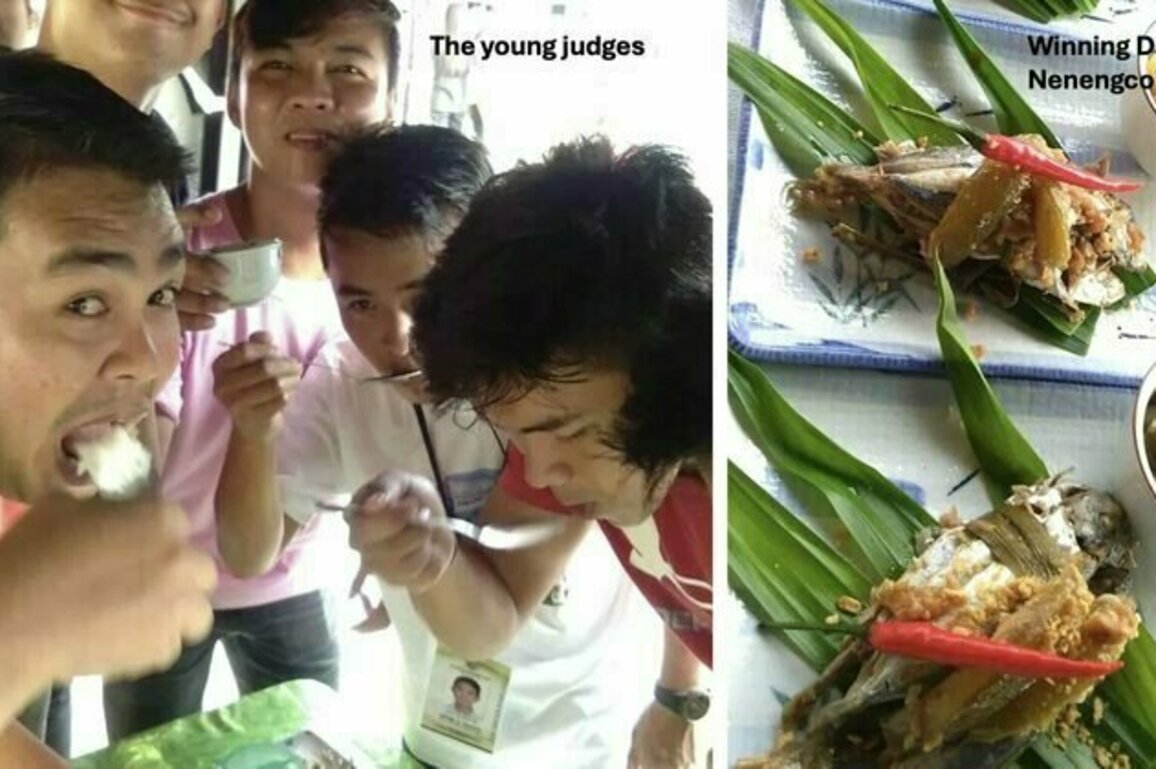
Since then, Amparo had made her mark. She won the Ginangang Galunggong cooking contest sponsored by the municipal government in 2019. Her winning recipe uses aromatic Pandan, Pandanus amaryllifolius, instead of banana leaves to bundle the fish. She adds lemon grass, chillis, coconut oil, and a secret ingredient to spice it up. She gushed that her innovation was a big hit among the youth who were judging. They loved her less-fishy version.
As the 2019 Ginangang Galunggong champion of the Atimonan Tagultol Fishing Festival, Amparo was invited to sell at the Niyogyugan Festival in Lucena, the provincial capital. There, the governor who sampled her Ginanga requested her to judge other cooking contests. And more importantly, asked her to continue participating as a vendor thereafter.
Today, aside from preparing Atimonan favorites like Pinangat, taro leaves cooked in coconut milk, Amparo cooks Ginanga for Balik-Bayan Filipinos. Those returning home after living overseas seriously crave them. They order these everyday dishes as fiesta fare. But instead of Galunggong, Amparo uses Buyo, the local Tuna for her Ginanga. She even pounds the bigger, firmer fish to tenderize and enhance its absorption of flavors.
Can the Catch Sustain Demand?
Many Filipinos rely on fish for food, and their numbers have increased. The Philippine 2020 Census reported that the municipality of Atimonan had 68,857 people. In 1980, just before Lavides and Amparo left town to work in Manila, Atimonan had half that at 33,300. In Metro Manila, the fish catches destination, the population was 13,484,462 in 2020. Forty years earlier, 5,925,884 people called it home.
Marine Conservationist Dr. Margarita Lavides and team asked 2,655 fishers, aged 21 and older, how much fish they recalled catching from the 1950s to 2014. Analyzing the responses, the researchers inferred which fish species disappeared from their catches in five marine conservation sites.
In 2016, Lavides and team published their findings in an open-access article on the PLOS One Journal. They reported that fifty-nine (59) different finfish disappeared from catches between 1950 and 2014. Fishers reported zero catches of five important fish species in the sites they studied: (1) green bumped head parrot fish, (2) humphead wrasse, (3) African pompano, (4) giant grouper, (5) mangrove red snapper.
Serendipitously, Nenengco De Guia Amparos first job in Manila, in 1982, was with scientist Dr. Inocencio Ronquillo of the Philippine Bureau of Fisheries and Aquatic Resources (BFAR). Ronquillo earlier wrote a review of Galunggong in the Philippines in 1975.
In 2024, Drs. Jobelle Tapia and Mudjekeewis Santos updated this review on Galunggong (Decapterus spp.) in the Philippines. They concluded that Round Scad species are the most harvested fish in the country, and catch had decreased in the last 30 years of assessment.
Steps to prevent fish populations from collapsing are already underway. Marine environments (or ecosystems) need time to recover if life within them were to regenerate. So, local and national governments, along with coastal communities, have begun setting aside protected areas. Together, they restrict fishing in these designated waters and enforce other conservation measures.
Amparo mentioned a seasonal ban on fishing Galunggong implemented in Atimonan. The BFAR-mandated fishing closure protects fish during peak spawning periods, allowing adults to reproduce and the juveniles to grow.
Will there be enough Galunggong for the younger generations of Atimonan to enjoy Ginanga? Both Lavides and Amparo think so.
About the Author:
George Banez is a writer of Filipino descent and is a retired non-profit professional living in Florida.
Pressenza Philippines